 Skip to content

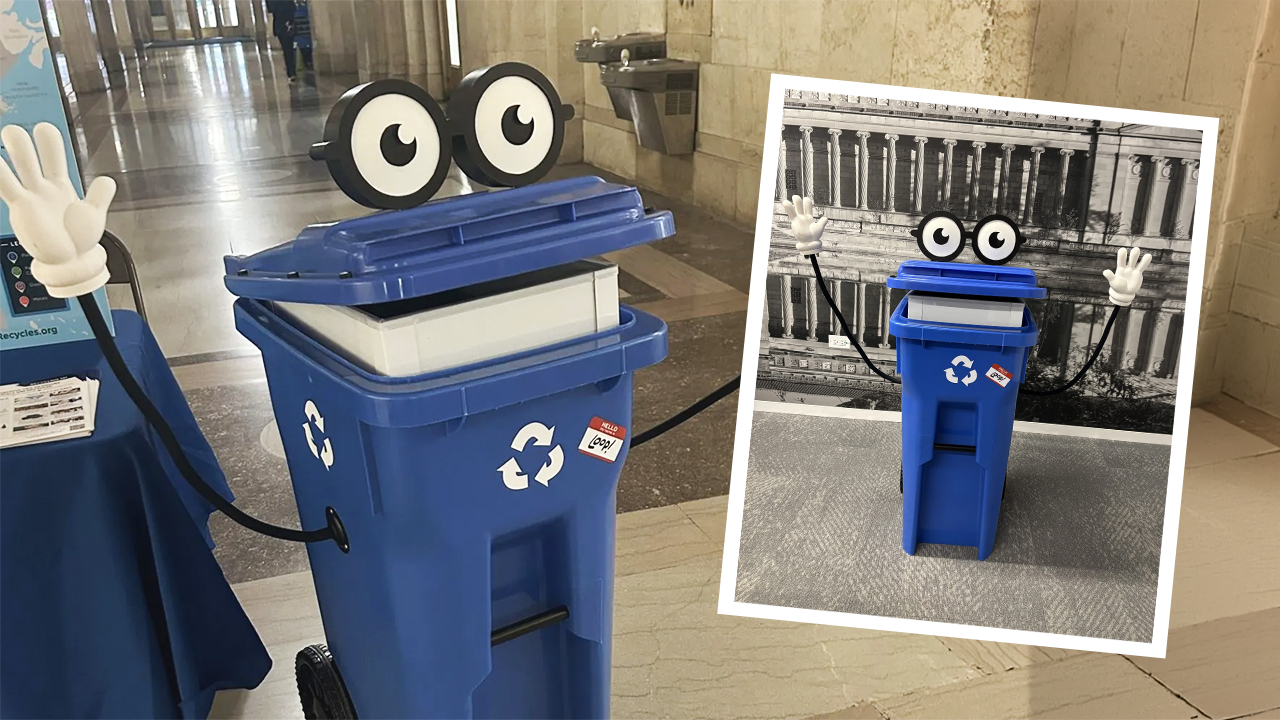
Googly eyes and a blue bin: Meet Loop, Chicago’s new recycling mascot
By Nina Metz | nmetz@chicagotribune.com | Chicago Tribune
- April 15, 2026
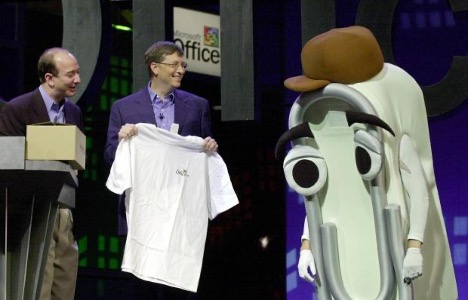
Thirty years ago, if you were using a Microsoft product, chances are you’re familiar with Clippy. The animated “assistant” was little more than a paperclip with a pair of eyebrows framing its googly eyes, popping up in the corner of your screen asking, “Would you like help?”
No! Go away!
But maybe you were tempted to let Clippy stay, like a digital pet that had quietly wandered over to express curiosity before settling in to keep you company.
I was recently reminded of Clippy when I came across a photo of a blue recycling bin called Loop. He has a pair of begloved arms and, yes, googly eyes. In short, he is a recycling mascot for Chicago.
The photo was posted to social media on April 1. Was this an April Fool’s joke? When I reached out to the Department of Streets and Sanitation, I was informed Loop is real. Loop is real!
Loop was created by Güd Marketing for a recycling awareness campaign that includes billboards and videos called “Feed the Cart” for Chicago and neighboring municipalities.
“We pitched the mascot in response to some of the research we had collected,” says Güd creative director Drew Smith. “Chicago has a pretty good recycling rate, but there was a plateau on the goals they were trying to reach, so we wanted to address that decreased enthusiasm. The research also showed there was some confusion on the rules — people putting things in the recycling bins that weren’t actually recyclable. So we thought why not do a kooky, fun mascot that gets people motivated and educated?”
The Güd team originally considered anthropomorphizing a piece of recyclable paper as the mascot.
“But then we were thinking about curbside bins and making sure people knew what would go in those to satisfy the ‘hunger’ for recyclables, so it made more sense that the curbside bins look like a fella with a mouth,” he said.
They even devised a personality for him: “Friendly, excitable and a little silly. He speaks in upbeat, simple and straightforward language to let you know what he can and can not eat.”
Can slapping googly eyes on an inanimate object actually be effective from a psychological standpoint?
“This is deceptively effective!” says James Mourey, a marketing professor at DePaul University.
“Beyond novelty — which captures attention — actively anthropomorphizing something, even a recycling bin, taps into empathy, emotion and perceived warmth, which can trigger greater recycling behavior. It sounds silly, but it’s all in the realm of ‘nudges,’ or the subtle ways in which we sort of hijack what we know about human cognition and emotion to elicit a certain behavior.”
Anthropomorphism means attributing human characteristics to non-human objects. What a strange compulsion. And yet it’s one to which we’re all susceptible.
“We know from neuroscience research that the brain responds to the shape of a face,” Mourey says. “So anytime you get two eyes and a mouth, we’re there. Why the eyes are googly (on many mascots), I don’t know! But the use of eyes is a simple cue that something is alive, there’s a face there, and we’re designed to see that. So anything where we get two eyes and a mouth, we respond.”
He described a study involving a poster that consisted of two horizontal lines, like dashes, which were eyes, and then a third, longer line below it, which was a mouth.
“They took that poster and left it in a room where people were doing math questions. And for the control group, they took the same poster and turned it 90 degrees, so it no longer looked like a face, it just looked like three random vertical lines. And what they found, when it was oriented like a face, it actually reduced cheating. So just the imagined presence of a face led people to cheat less.”
According to Mourey, we treat things differently when we think they’re alive.
“If you describe something using pronouns — referring to the recycling bin mascot as ‘he’ rather than ‘it’ — that contextualizes it as a living thing. It’s a signal. It all speaks to priming behavior, where you’re trying to change the way people are processing information. There’s this idea that we assess people on two dimensions: Their competence and their warmth. By nudging or priming people with these human-like cues, then that shifts us more into the warmth dimension. In this case, it makes recycling seem warmer.”
Without the mascot, “you’re just recycling,” he says. “The thing about Loop as a character, now you’re feeding the bin. And that might be problematic because you might decide to throw everything in that bin.”
Actually, Güd thought of that when creating the mascot’s personality: “The only time he’s negative is when he’s offered food that gives him heartburn or upsets his stomach,” says Smith. “Things like batteries, definitely a no-no for Loop.”
Anthropomorphizing doesn’t always achieve the intended effect. M&M’s, the candy, also exist as characters: Arms, legs, a mouth and googly eyes. “I remember my godmother, she could not eat M&M’s after watching those commercials, and that was so strange to me because I was like, clearly this is an anthropomorphic character,” Mourey says. “It’s a spokescandy.”
Building contractors have also been known to put enormous googly eyes on their excavation equipment, perhaps to make them seem less imposing or destructive to a neighborhood’s sensibilities.
On the opposite end of the anthropomorphism spectrum is a mascot like Mr. Peanut, with arms and legs and a face, but, pointedly, no googly eyes. In fact, he has accessories: A top hat and a monocle. You can admire Mr. Peanut for the character’s design, but it is not “cute” in the same way Loop or even Clippy are cute. “Essentially, he is an anthropomorphic quality of people we don’t tend to like,” Mourey says, “which are snobby, wealthy, uppity types. You can anthropomorphize negative traits as effectively as positive traits.”
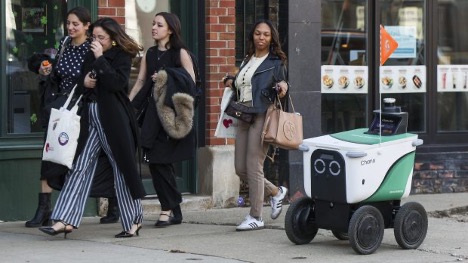
Automobiles have always had a vague anthropomorphic quality, with the two headlights suggesting eyes and the grill a mouth. Perhaps that’s why food delivery robots, which have become notorious for smashing the glass of Chicago bus stops, have two white circles on their front-facing side where headlights would be. And yet, the inclusion of “eyes” hasn’t softened most people to the presence of these robots.
Mourey has a different theory. “Maybe we hate them less than if they didn’t have those eyes. Plus, a lot of them have human names. I think people have an aversion to them in general, but imagine a world in which the robots were introduced without eyes, without names, maybe a different shape, we probably would have hated them more.”
True; imagine if they looked like Daleks from “Doctor Who” instead!
Beware the downside, though. A decade ago, Mourey published a study with the title: “Products as Pals: Engaging with Anthropomorphic Products Mitigates the Effects of Social Exclusion.”
In short, he and his co-authors found that the lonelier you are, the more likely you are to anthropomize. If you work at home by yourself all day, Clippy might be your best friend. But it’s a false social experience.
“What we found is that anthropomorphizing something like a calculator or a vacuum essentially fulfilled social needs that you normally would fulfill by engaging with real people. So on one hand, if you have an elderly person who lives alone, giving them something anthropomorphic, like a toy dog or even a digital assistant like Alexa, it’s helpful in mitigating feelings of loneliness. But the flipside is that we start replacing our actual genuine interpersonal relationships with relationships with vacuums or calculators or Clippy. Or AI. So it’s a mixed bag.”
And anthropomorphic interactions are frictionless, unlike human interactions, which can be fraught and complicated at times. Relying on an anthropomorphic object for social fulfillment means someone runs the risk of becoming unaccustomed to social situations where their every utterance isn’t affirmed.
“A chatbot can seem like the perfect relationship,” Mourey says. “It’s the relationship you want, when you want it. Whereas think about any interpersonal engagement, whether it’s with colleagues or a romantic partner, well, now you’re dealing with a person who may or may not be in a good mood, or may or may not be available.”
Not that anyone is likely to form this kind of unhealthy attachment to Loop. The name refers to the lifecycle of recycling materials. “Glass and metal are infinitely recyclable, so that loop is something we wanted to refer to,” says Güd’s Smith. “But also because he’s living in the Chicagoland area and that reference to the business district felt like a no-brainer.”
Still, Loopy seems like the more obvious name.
“Part of Clippy’s unappeal,” Mourey says, “was its intrusiveness. Make it go away! And now we’re facing that with AI, where every five seconds you have a chatbot popping up in the corner of a website and it’s like, ‘No, no, I don’t need you.’ So there’s the anthropomorphic piece, but there’s also the intrusiveness piece. We might be fine with an anthropomorphic character, but we’re not fine with anything being shoved in our face.
“But for the record, Loopy is a much better name than Loop.”
Mourey is also curious about the campaign’s key performance indicators. “Are they tracking an increase in recycling? An increase in accurate recycling? It’s cute to do it, but then you have to measure the effectiveness, and my guess is you would see an uptick in recycling.”
From a marketing perspective, he says the mascot takes up mental real estate in a good way, “where you have positive associations because it’s cute and memorable and you’re associating the image with something tangible: Recycling.
“When you think about government, or even recycling, unless you’re a diehard politico or a diehard environmentalist, these are things that are typically boring for most people. Not everybody. But for most people. So adding some silliness to it, some fun, what’s the harm?”
According to Streets and Sanitation, there will be opportunities to encounter Loop at events, but there are no plans yet to put him on public display.