 Skip to content

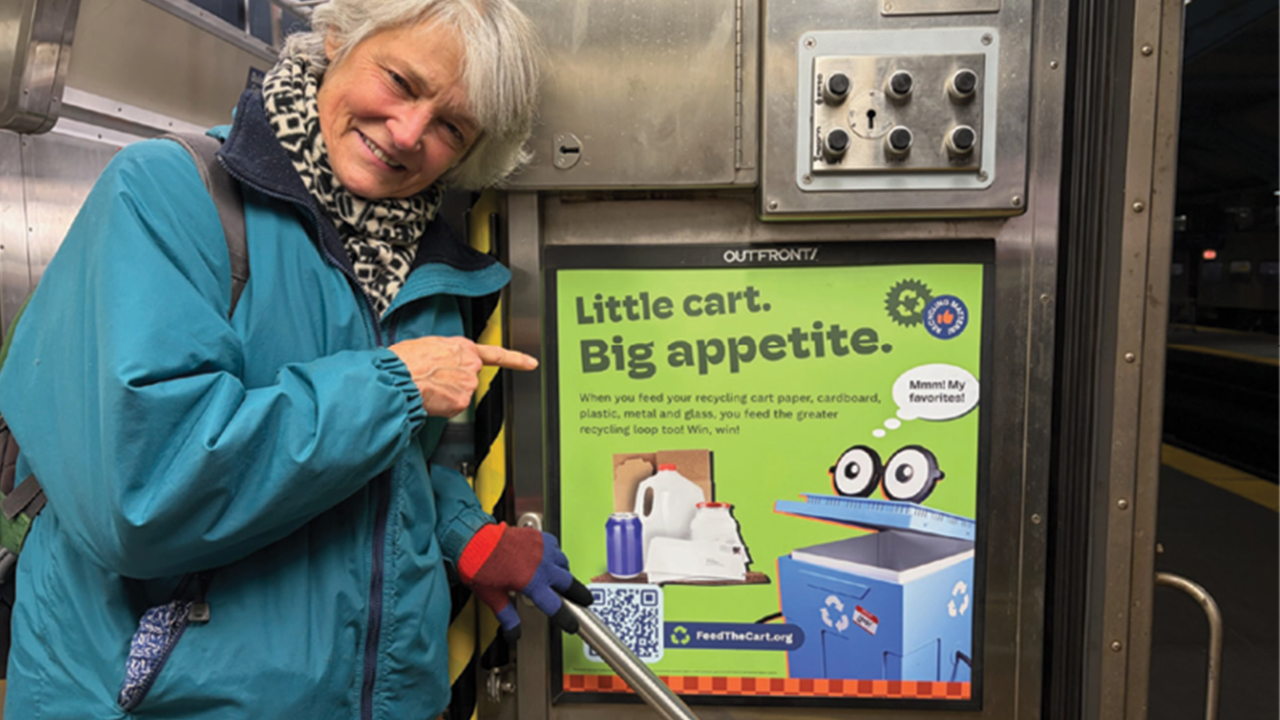
Confusion around and distrust in recycling has limited the success of residential recycling programs over the years. When a community has access to curbside recycling services but residents still harbor misunderstandings about how and what to recycle, contamination persists, decreasing the recovery of collected materials and posing safety risks for material recovery facility (MRF) employees.
Chicago’s Metropolitan Mayors Caucus (MMC), a partnership of 275 local governments in Metro Chicago, is aiming to boost residential recycling tonnage by 15 percent before 2030 through its new Feed the Cart campaign, combating contamination in the process.
Officially launched in October 2025, Feed the Cart is being lauded by MMC as the largest recycling education and outreach campaign in Illinois’ history. The program unites six of the state’s most populous counties—Cook, DuPage, Kane, Lake, McHenry and Will—representing more than 8.1 million residents. The program was made possible through a $2 million Recycling Education and Outreach (REO) grant from the U.S. Environmental Protection Agency (EPA) that was awarded in November 2024.
Edith Makra, director of environmental initiatives at MMC, says the caucus became interested in the REO grant opportunity after current Executive Director Neil James joined the organization in 2022.
“We have hundreds of municipalities that support common consensus goals, and recycling has always been an important topic of conversation,” Makra says. “The mayors caucus, at a regional level, … hadn’t really engaged much [with recycling initiatives]. We had, at the time, a new executive director, who actually came from a small solid waste agency, and the grant opportunity was what really piqued our interest.”
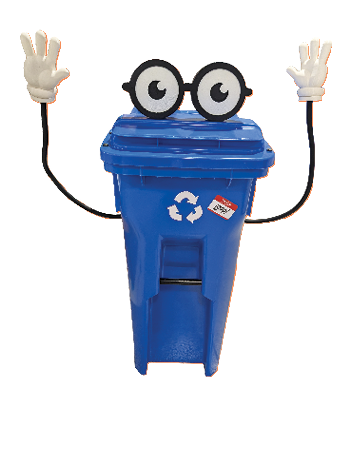
The program’s mascot, a cartoon recycling cart called Loop, was developed by MMC in partnership with Lansing, Michigan-based Güd Marketing to help disseminate recycling information and build enthusiasm for the program, which will be evaluated for effectiveness in 2027.
Better together
Unique in size and structure, MMC says Feed the Cart is the first regional recycling effort in Metro Chicago, uniting its municipal partners for the first time.
Makra says many of MMC’s county-level solid waste agencies were planning to apply for the EPA REO grant independently, but when asked to join forces instead, the caucus’ municipal partners gave a resounding, “Yes.”
“Either we work together, or we compete against one another,” Makra says.
The scope of MMC’s proposed REO campaign contributed to its selection as a grant recipient, according to the EPA.
“The project MMC outlined shows a wide reach throughout the Chicago metropolitan area with use of evidence-based outreach and messaging and MMC’s strong partnerships and community ties,” a representative from EPA’s press office confirms in an email to Recycling Today. “The creation and reach of Loop are good examples of the creativity this program uses to improve participation in local recycling.”
To better understand the region’s recycling pain points and how to develop the program’s unified marketing strategy, MMC first had to evaluate Chicagoland’s 2024 waste and recycling data.
“Our grant Scope of Work said, ‘Hey, we’re going to go get data for all these towns on how much garbage they generate, how much recycling, … and then we’re going to calculate a recycling rate by using those two data points for each town,’” says Walter Willis, the executive director at the Solid Waste Agency of Lake County (SWALCO).
Chicagoland’s average recycling rate is 20.5 percent, equal to approximately 591 pounds of recyclables per household per year, 94 percent of which have access to curbside recycling.
The program also evaluated MRF data and found that 23 percent of collected materials go to landfill because of contamination and infrastructure limitations.
One of the program’s goals is to dispel misconceptions and confusion around recycling while building trust with participants, which includes clarifying what is accepted in Metro Chicago’s recycling programs.
“Chicago stumbled and bumbled with the blue bag program decades ago, and that created distrust because you were throwing it in with the garbage and hoping that they plucked it,” Willis says.
Although the blue bag program was replaced with the blue cart program in 2008, Willis says many residents continue to bag recyclables, contributing to contamination and safety risks at the MRF level.
Building enthusiasm
Developing the messaging for the Feed the Cart program was no easy task.
“We needed to build something that could be flexible enough to be implementable by a small local government, one of our 275 partners, but also [can] catch the attention in a saturated media market around Chicago,” says Chelsea Maupin, senior strategist and research manager at Güd Marketing. “How do we stand out from big brands and get people to actually pay attention?”
Güd Marketing met with each municipal partner to discover which type of messaging has worked for communities in the past.
“A lot of our foundational research was based on tried executions across our different partners,” Maupin says.
The firm incorporated findings from its previous work with the Solid Waste Authority of Central Ohio as well as its experience developing the Recycling Racoons program in Michigan.
“We took a little bit of our Midwestern Great Lakes primary research, we coupled that with lived experiences in Chicagoland and then we also tied in some of the findings we see coming out of The Recycling Partnership,” she says. “They’ve got a lot of great best practice for what kind of messaging actually changes behavior and sticks with people.”
The overarching messaging the team landed on leans into positive language, simplicity and enthusiasm, focusing on clarifying what can go in the recycling cart rather than listing prohibited items.
“What I heard was this expert way to let the very positive messaging float to the top,” Makra says. “No more ‘don’t posters’ with the dozens of products. … Make the blue cart with the big eyes happy, give him these four things, and we can all agree to that.”
Thus, Feed the Cart was born.
Residents are encouraged to “feed” Loop his “favorite foods,” which include the region’s most commonly accepted recyclables, namely old corrugated containers (OCC), mixed paper, aluminum cans, glass bottles and jars, high-density polyethylene (HDPE) jugs and polyethylene terephthalate (PET) bottles.
“It’s more about getting people excited about recycling again and not shaming you or confusing you,” Willis says. “Keep it simple.”
To make a splash when initially announced, Feed the Cart launched primarily with out-of-home media, including billboards and ads on Chicago Transit Authority (CTA) buses and trains.
“Reaching people with recycling enthusiasm messages outside of their home is a little counterintuitive, but we wanted to … get a lot of eyeballs on it very quickly,” Maupin says. “Catching that attention in a big, splashy initial way helps people notice it and pay attention to it as we start doing … more in-home messaging as the campaign keeps going.”
Community engagement
Feed the Cart launched its website last October and has established a presence on social media to reach Chicagoland residents at home.
The program has partnered with Recycle Coach to provide clarity on where to recycle things like polystyrene foam, shredded paper and batteries. A Recycle Coach search feature is embedded on the Feed the Cart website, allowing a resident to select his or her municipality before searching for the recyclability of certain materials and if drop-off programs exist in their area.
Juliet Mathey, recycling education and outreach specialist at MMC, has taken an in-person approach to share the program’s message.
“We go out and table at community events, and I bring along different things to engage with the audience,” she says. “It draws kids in, and then the parents will learn alongside them.”
Community members can test their recycling knowledge at Feed the Cart’s table, while Mathey answers questions about how to keep hard-to-recycle materials out of the landfill.
“With education, we’re trying to make things tactile so that it develops a little bit differently in your brain [and] you can recall it,” she says. “One thing that people often feel confused about when it comes to recycling is that they’re hearing all this different information, and it’s hard to figure out what is correct, what’s not. We’re just trying to make everything streamlined and easily accessible.”
Physical educational materials are available in both English and Spanish, while digital materials are also available in Arabic, Chinese, Hindi and Polish.
For some residents, language accessibility was the missing piece to understanding Chicago’s recycling guidelines.
SWALCO implemented a bilingual educational cart tagging program in Waukegan and Zion through Feed the Cart after local hauler, Rosemont, Illinois-based LRS, established a punitive cart tagging program in Waukegan.
“If you get tagged three times [by LRS] for not using your cart correctly or putting the wrong items in there, then they’ve been taking people’s carts away,” Willis explains.
To help people keep their carts, SWALCO worked with LRS and environmental consulting firm GreenLit Solutions to evaluate residents’ recycling carts, tagging misused bins with educational materials in both English and Spanish.
“Waukegan has a fairly significant Hispanic population, and we did identify that that was an issue for people to understand the rules,” Willis says.
Carts were tagged and monitored by SWALCO’s street team for four weeks from October to November 2025, and by the end of the evaluation period, misuse of recycling carts in Waukegan decreased from 60 percent to 25 percent, while misuse in Zion shrank from 50 percent to 27 percent.
Support from regional haulers has been crucial to the program’s development.
Phoenix-based Republic Services is working with Feed the Cart and DuPage County to update its educational and outreach materials, while waste and recycling services provider Groot, a Waste Connections company, is developing a video with Feed the Cart to shed light on contaminants and MRF operations.
Groot operates two MRFs in the Chicagoland region, one of which was rebuilt in 2024 after a fire devastated the facility. Based on the fire’s heat signature, it’s suspected to have been caused by an improperly discarded battery.
This is the first time in 30 years an REO grant of this size has been awarded to the state of Illinois, but the funding won’t be around forever.
“The grant funding is limited, but we want this campaign to be something that unites the region and is able to be carried forward long term,” Maupin says. “Aspirationally, I would love for Loop to be the Smokey Bear of Chicagoland recycling in 50 years.”
“We have some really unique tools for communicating messaging,” Makra adds. “We get to continue to amplify that message, and that’s something I think will endure and create that … recycling works type of momentum we’re looking for.”